Introduction to The Oracle Database Administration
3 1/2 hours of video instruction PLUS the Oracle DBA Interactive Workbook e-Book, by the Columbia University instructors, Melanie Caffrey & Douglas Scherer.
Master the basics of Oracle database administration�now!
Managing the database and its physical layout, ensuring security and data integrity, providing for backups, PLUS the History of Oracle Networking.
See it, hear it, do it !
Dont just read about database administration !
Watch and listen as your instructors use 31/2 hours of video instruction to cover the key topics, and then add step-by-step digital videos, real-world labs, exercises, projects, and insight from the trenches to explore what it means to be an Oracle DBA.
Key Topics :
Covers all key aspects of day-to-day Oracle database administration, including:
Creating new databases
Managing physical database layouts
Administering users, privileges, and resource groups
Tuning Oracle and SQL code for maximum performance
Security, auditing, and data integrity
Backup, recovery, and much more!
Download Code:
http://rapidshare.com/files/22579748...part4.rar.html
http://rapidshare.com/files/22579757...part5.rar.html
http://rapidshare.com/files/22579789...part3.rar.html
http://rapidshare.com/files/22579797...part1.rar.html
http://rapidshare.com/files/22579813...part2.rar.html
Seriously U want - 100 EURO DOLLARS - Check it

Monday, September 7, 2009

Tuesday, February 3, 2009
Sirius Satellite Radio - iPhone Application
 Sirius Satellite Radio iPhone App Could Come Within a Week
Sources close to Orbitcast have revealed that Sirus is finally submitting their uSirius StarPlayr to the App Store this weekend. Once accepted, subscribers will be able to enjoy Sirius XM on their iPhone.
With Sirius being so late to the party, the only question is whether the service is really worth paying for when there are so many good, free streaming apps out there like Pandora and Slacker. [Orbitcast via The Motley Fool
Saturday, January 17, 2009

Saturday, December 27, 2008
Top 10 of World Wide Everything...! Part # 2
Here you can find Top 10 of Everything listed on a single click. To make it easy to browse, I made it into parts and the rest of the Top 10 listed categories are following on the way.
Here is the part #2...


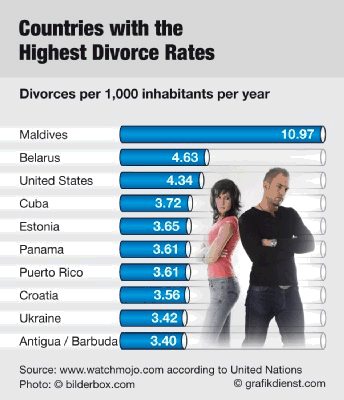


 Hope you find it intresting !... keep reading for more Top of the Tops.
Next coming list includes, Top Vacation spots, Automobiles, Business & Consumer products etc.,
Please do not forget to Send a mail or Comment / Suggestions or e mail to: telugumoviesjack@gmail.com
Here is the part #2...


 Hope you find it intresting !... keep reading for more Top of the Tops.
Next coming list includes, Top Vacation spots, Automobiles, Business & Consumer products etc.,
Please do not forget to Send a mail or Comment / Suggestions or e mail to: telugumoviesjack@gmail.com
Wednesday, December 24, 2008
.NET Improvements in Service Pack 1 for VS 2008 and .NET FX 3.5
Performance improvements in Service Pack 1 for VS 2008 and .NET FX 3.5
We just announced the release of Service Pack 1 for VS 2008 and .NET FX 3.5. A major push for this release was continuing to enhance performance and reliability, as Soma noted in his most recent blog entry. I want to take a minute to drill into the major performance improvements you will find in this release of Visual Studio.
Framework Performance Enhancements
NET FX (CLR):
· New .NET Framework Client Profile - a smaller .NET Framework redist optimized for .NET client applications. The new redist weighs in at around 28 MB, enabling a smaller, faster, more reliable installation experience for .NET client applications on machines that do not already have the .NET Framework installed. The framework was refactored so that it now includes system core libraries and components (including LINQ), language support, XML, Windows Forms, WPF, Deployment, Web Services remoting and serialization, data access, and a few others. See the BCL Team blog for the full list and more details.
· Client applications should also see an improvement in cold startup scenarios especially for rich graphics WPF-based apps.We also made improvements to the working set of Ngen’d images, which also helps cold startup scenarios .
· Support for Address Space Layout Randomization (ASLR) on Vista and WS 2008. ASLR uses fast kernel mode virtual base address relocation to improve both memory layout and security.
WPF:
· Cold startup up to 40% faster, depending on the scenario and application size, without the need to modify any of your code.
· Additional support for text and graphics to deliver better performance. For example, effects like DropShadow and Blur were initially implemented using software rendering; with SP1 these are now implemented using hardware acceleration.
· Faster text rendering, mostly when used in specific scenarios such as VisualBrushes, DrawingBrushes, and Viewport2DVisual3D.
· Scrolling improvements with Container Recycling.
· Improved working set using TreeView virtualization
· A much improved WriteableBitmap that enables real-time bitmap updates from a software surface.
Jossef Goldberg’s blog is a great source of information on WPF performance tips and tricks. His detailed list of SP1 performance improvements is posted here.
WCF:
· Support for asynchronous HTTP module/handlers on IIS 7.0. Supports better thread management and improved throughput for systems with heavy backend processing requirements. (See Wenlong’s blog for the technical details.)
Windows Forms:
· General performance improvements, mostly due to underlying improvements in the CLR.
Data handling:
· Improved throughput in ADO.NET scenarios (2x+ requests/second for some scenarios).
· Performance improvements in XLINQ over XML containing many small elements.
Visual Studio Performance Enhancements
Visual Web Developer:
· Improved typing performance in the designer in complex pages (especially with MutiView control) 100x
· Fixed the issues with Switching to Design View.
· Opening Web Sites is up to 10x faster!
· Building Web Sites is up to 3x faster!
· Opening Web Forms is up to 2x faster!
· General performance improvements in startup and shutdown.
· Plus lots of new features and fixes (see the team blog).
Visual Basic .NET:
· Performance improvements in Intellisense and listing errors.
· Improvements in compiler and build throughput (most notably for projects with large amounts of XML comments in a single file)
Visual C#:
· Up to 2x improvements in bringing up Intellisense with a large number of types.
XAML Editing:
· Improved designer startup and form load time.
Debugging:
· Improvements in symbol and source downloading and the ability to cancel out of symbol download from a slow symbol server.
· Fix to a performance problem in the debugger when you are stepping through source code that is downloaded from Microsoft Reference Source Server that was caused by downloading the source files again for each breakpoint. Previously released as KB944899. (Please uninstall this KB before installing the SP.)
XML Editing:
· Loading XML is up to 3x faster!
· Improved editing performance.
Team Foundation Server:
In this Service Pack, a large part of the focus was to improve the performance and scalability of Team Foundation Server. Key changes include faster synchronization with Active Directory, improved check-in concurrency, a faster way to create source tree branches, online index rebuilding for less maintenance downtime and better support for checking very large sets of code.
TFS improved the number of projects a server can support. You should experience better scalability of the server, as well as the client experience when connecting to a server with a large number of projects on it.
· Opening Source Controlled Solutions is up to 2.5x faster!
· Deleting files is up to 2x faster!
· Improved Work Item performance (loading, saving, querying).
· Improved UI navigation performance.
· Improved performance working with TFS work items in Excel and Project
· Improved performance and reliability of the Visual SourceSafe migration tool.
· See Brian Harry’s BLOG for more about the Service Pack Release and Team Foundation Server improvements and scalability.
Other:
And, of course, there are lots of new features including the new Data Entity Framework, ADO.NET data services, support for SQL Server 2008’s new features, updated components for Visual Basic and Visual C++ (including a MFC-based Office 2007 Ribbon), and new designer capabilities that improve performance indirectly by improving developer productivity.
Some of these performance fixes were previously released as hot fixes (see our blog on the beta). If you installed some of those hot fixes you may need to remove them before installing the Service Patch. See the release notes on the download page for more information.
Should you encounter any performance problems we’ve missed, please continue to let us know here on the blog or by e-mail to devperf@Microsoft.com.
We just announced the release of Service Pack 1 for VS 2008 and .NET FX 3.5. A major push for this release was continuing to enhance performance and reliability, as Soma noted in his most recent blog entry. I want to take a minute to drill into the major performance improvements you will find in this release of Visual Studio.
Framework Performance Enhancements
NET FX (CLR):
· New .NET Framework Client Profile - a smaller .NET Framework redist optimized for .NET client applications. The new redist weighs in at around 28 MB, enabling a smaller, faster, more reliable installation experience for .NET client applications on machines that do not already have the .NET Framework installed. The framework was refactored so that it now includes system core libraries and components (including LINQ), language support, XML, Windows Forms, WPF, Deployment, Web Services remoting and serialization, data access, and a few others. See the BCL Team blog for the full list and more details.
· Client applications should also see an improvement in cold startup scenarios especially for rich graphics WPF-based apps.We also made improvements to the working set of Ngen’d images, which also helps cold startup scenarios .
· Support for Address Space Layout Randomization (ASLR) on Vista and WS 2008. ASLR uses fast kernel mode virtual base address relocation to improve both memory layout and security.
WPF:
· Cold startup up to 40% faster, depending on the scenario and application size, without the need to modify any of your code.
· Additional support for text and graphics to deliver better performance. For example, effects like DropShadow and Blur were initially implemented using software rendering; with SP1 these are now implemented using hardware acceleration.
· Faster text rendering, mostly when used in specific scenarios such as VisualBrushes, DrawingBrushes, and Viewport2DVisual3D.
· Scrolling improvements with Container Recycling.
· Improved working set using TreeView virtualization
· A much improved WriteableBitmap that enables real-time bitmap updates from a software surface.
Jossef Goldberg’s blog is a great source of information on WPF performance tips and tricks. His detailed list of SP1 performance improvements is posted here.
WCF:
· Support for asynchronous HTTP module/handlers on IIS 7.0. Supports better thread management and improved throughput for systems with heavy backend processing requirements. (See Wenlong’s blog for the technical details.)
Windows Forms:
· General performance improvements, mostly due to underlying improvements in the CLR.
Data handling:
· Improved throughput in ADO.NET scenarios (2x+ requests/second for some scenarios).
· Performance improvements in XLINQ over XML containing many small elements.
Visual Studio Performance Enhancements
Visual Web Developer:
· Improved typing performance in the designer in complex pages (especially with MutiView control) 100x
· Fixed the issues with Switching to Design View.
· Opening Web Sites is up to 10x faster!
· Building Web Sites is up to 3x faster!
· Opening Web Forms is up to 2x faster!
· General performance improvements in startup and shutdown.
· Plus lots of new features and fixes (see the team blog).
Visual Basic .NET:
· Performance improvements in Intellisense and listing errors.
· Improvements in compiler and build throughput (most notably for projects with large amounts of XML comments in a single file)
Visual C#:
· Up to 2x improvements in bringing up Intellisense with a large number of types.
XAML Editing:
· Improved designer startup and form load time.
Debugging:
· Improvements in symbol and source downloading and the ability to cancel out of symbol download from a slow symbol server.
· Fix to a performance problem in the debugger when you are stepping through source code that is downloaded from Microsoft Reference Source Server that was caused by downloading the source files again for each breakpoint. Previously released as KB944899. (Please uninstall this KB before installing the SP.)
XML Editing:
· Loading XML is up to 3x faster!
· Improved editing performance.
Team Foundation Server:
In this Service Pack, a large part of the focus was to improve the performance and scalability of Team Foundation Server. Key changes include faster synchronization with Active Directory, improved check-in concurrency, a faster way to create source tree branches, online index rebuilding for less maintenance downtime and better support for checking very large sets of code.
TFS improved the number of projects a server can support. You should experience better scalability of the server, as well as the client experience when connecting to a server with a large number of projects on it.
· Opening Source Controlled Solutions is up to 2.5x faster!
· Deleting files is up to 2x faster!
· Improved Work Item performance (loading, saving, querying).
· Improved UI navigation performance.
· Improved performance working with TFS work items in Excel and Project
· Improved performance and reliability of the Visual SourceSafe migration tool.
· See Brian Harry’s BLOG for more about the Service Pack Release and Team Foundation Server improvements and scalability.
Other:
And, of course, there are lots of new features including the new Data Entity Framework, ADO.NET data services, support for SQL Server 2008’s new features, updated components for Visual Basic and Visual C++ (including a MFC-based Office 2007 Ribbon), and new designer capabilities that improve performance indirectly by improving developer productivity.
Some of these performance fixes were previously released as hot fixes (see our blog on the beta). If you installed some of those hot fixes you may need to remove them before installing the Service Patch. See the release notes on the download page for more information.
Should you encounter any performance problems we’ve missed, please continue to let us know here on the blog or by e-mail to devperf@Microsoft.com.
Secunia Personal Software Inspector 1.0 - will keep your software up to date.
Secunia Personal Software Inspector 1.0 - application
that will help you keep your software up to date.
The Secunia PSI works by examining files on your computer (primarily .exe, .dll, and .ocx files). These files contain non-specific meta information provided by the software vendor only. This data is the same for all users, and originates from the installed programs on your computer - never from their configuration. Please read the privacy statement available at the bottom of this page and through the Secunia PSI application for more details about how information from your computer is used by Secunia.
that will help you keep your software up to date.
The Secunia PSI works by examining files on your computer (primarily .exe, .dll, and .ocx files). These files contain non-specific meta information provided by the software vendor only. This data is the same for all users, and originates from the installed programs on your computer - never from their configuration. Please read the privacy statement available at the bottom of this page and through the Secunia PSI application for more details about how information from your computer is used by Secunia.
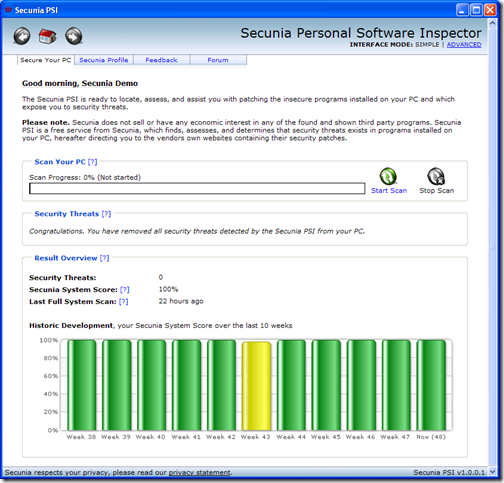
After examining all the files on your local hard drive(s), the collected data is sent to Secunia's servers, which match the data against the Secunia File Signatures engine (https://psi.secunia.com/) to determine the exact applications installed on your system.
This information can then be used to provide you with a detailed report of the missing security related updates for your system.
Purpose of the Secunia PSI
The Secunia PSI is an invaluable tool for you to use when assessing the security patch state of software installed on your system. It constantly monitors your system for insecure software installations, notifies you when an insecure application is installed, and even provides you with detailed instructions for updating the application when available.
It is NOT the purpose of the Secunia PSI to detect whether your system has already been compromised or if local changes, settings, or missing requirements could cause the Secunia PSI to report incorrect results. The Secunia PSI relies on the meta-data of executables and library files. The Secunia PSI does NOT conduct an integrity check of the individual files, rather, it checks whether a specific program is vulnerable according to the reported version numbers and not whether the files have been compromised or replaced by other users or programs.
The Secunia PSI is not a replacement for other security measures such as anti-virus or personal firewalls, the Secunia PSI is a great supplement to other security measures such as anti-virus and personal firewalls as it helps preventing exploitation of often overlooked exposures.
Additionally, it is important to understand that the process of identifying insecure software installations on any system involves many different factors and, in rare cases, may result in incorrect detections. Should you encounter such a situation, please send us your feedback and all relevant information at support@secunia.com.
Privacy Statement
Communication
All communication between your system (The Secunia PSI) and the Secunia servers (psi.secunia.com) is conducted via an encrypted connection (SSL). Effectively protecting against eavesdropping of the data and the results being exchanged with Secunia.
Data
All data sent to Secunia is treated as confidential.
The Personal Software Inspector collects unique text strings and data about executable files and installed applications on your system, including hostname and langroup, and Microsoft KB numbers. This data is analysed by the Secunia File Signature engine (psi.secunia.com) to determine the exact applications installed on your system. No other data is collected from your system.
This can in turn be used to provide you with a detailed report about the specific missing security related updates on your system.
The data sent to Secunia is non-personal data only. The data is generic, standardised, and originates from installed programs on your computer.
All data will be deleted automatically no later than 12 months after you terminate using the program or immediately after you cancel your registration.
Secunia will not share or sell specific data about individuals with any third parties. Only aggregate statistical which can't be related directly to any individuals will be published and shared with third parties.
Over 70% of youth never heard of globalisation
New Delhi: A section of Indian youth are still conservative in making friends outside their religious circles and more than a two-third have never heard about globalisation, said a report released here.
The report Indian Youth in a Transforming World: Attitudes and Perception was released by Centre of the Studies of the Developing Societies (CSDS) yesterday in collaboration with Konard-Adenauer-Stiftung (KAS), an international organisation with German roots.
The report said that only 29 per cent of the Indian youth have ever heard about globalisation while 66 per cent of them still consider alcohol as taboo. About 48 per cent said they have strong faith in the democratic values while 27 per cent were indifferent to these issues.
Presiding the event, noted psephologist Yogendra Yadav from CSDS said "the survey exposes the underlying attitude of the youth and tries to study political and social values prevalent among the India's youth population."
Family remains a key institution among the Indian youth with parental authority continuing to be crucial, with 60 per cent saying that final decision on marriage should be taken by parents.

"Family support system is invaluable." While 27 per cent of country's youth reported that they did not have friend from other gender, religion or caste.
Commenting on the fact that youth of the country is transforming but the politics is not, Lok Sabha MP Sachin Pilot a panel member said, "India politics is also changing and we will see much transformation during the next decade."
"There is disconnection between golabalisation and the Dalit youth of this country because youths belonging to that segment of the society are still concerned about social and political security like right to vote," a panelist, Bhanwar Meghuvanshi of Dalit Adhikar Avam Ghumantu Adhikar Abhiyan from Rajashthan said.
Source : PTI
Subscribe to:
Posts (Atom)